Bill Gates, chemtrails, and the ungoverned science that could reshape Earth’s climate
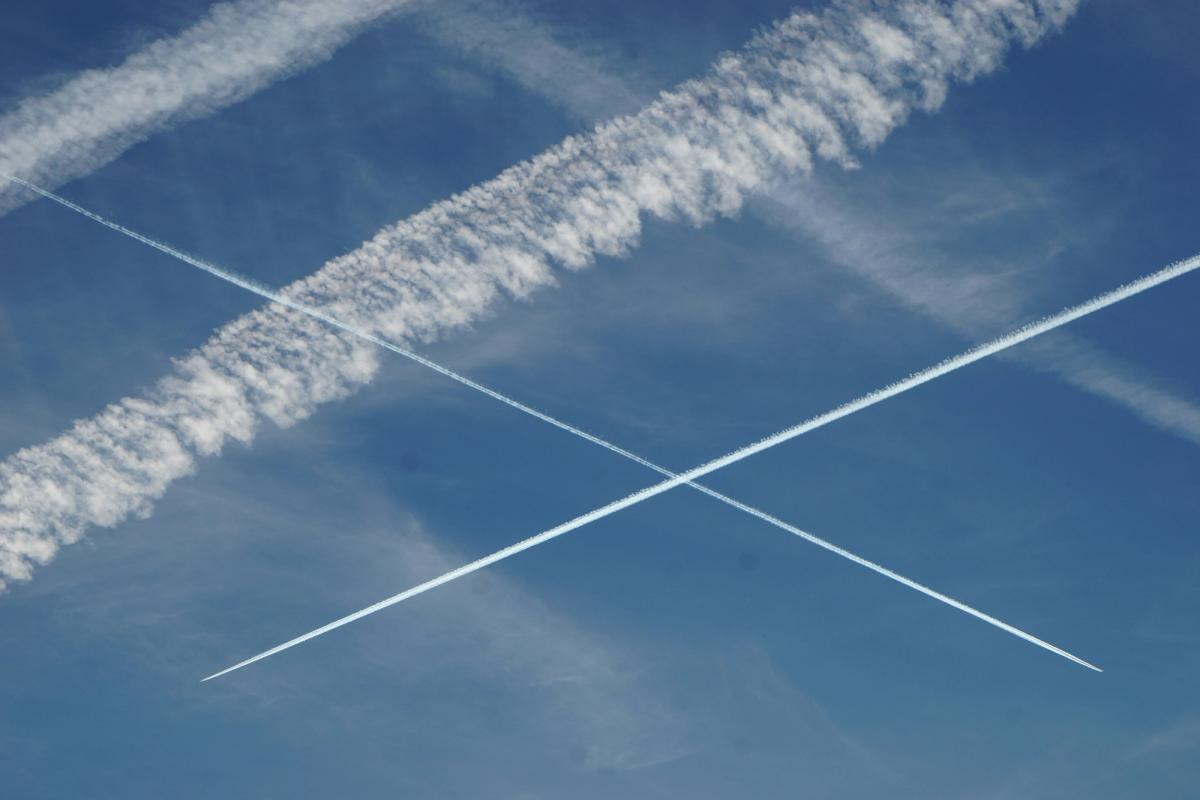
I’m sure by now many of you must’ve seen multiple chemtrails dividing your sky. These chemtrails at first glance may seem like just another contrails left by commercial aircraft, but - yes, you guessed it, these chemtrails last way longer and are way bigger than the usual Contrails left by aircraft. These chemtrails have become evidence, Evidence of spraying, Evidence of experiments, Evidence of Bill Gates’s experiment.
The internet is flooded with claims that Gates is engineering the atmosphere, poisoning the air, playing God with a planet that is not his to touch. These posts travel faster than fact-checks. Though these posts point in the direction of something that is real, they just get the story completely wrong.
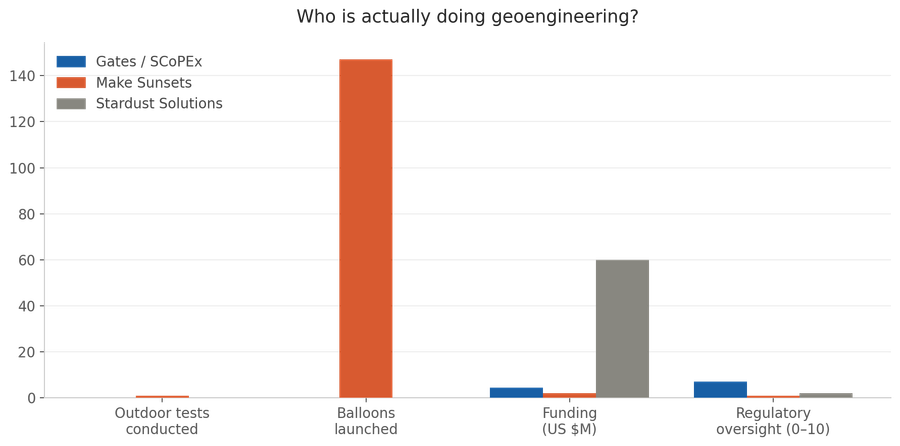
The truth is more interesting, more alarming, and more urgent than any conspiracy theory. Because while the internet argues about contrails, a two—person startup has already been quietly launching sulfur-filled balloons into the upper atmosphere, selling “cooling credits” to paying customers, and no government on earth has the legal authority to stop them.
What Gates is actually doing
So Bill Gates has been funding bioengineering research since 2007. Roughly over a decade now, he has contributed about $4.5 million of his own money to scientists studying ways to reflect sunlight into space; this technique is called solar radiation management, or SRM.
The headline project was based at Harvard University: the Stratospheric Controlled Perturbation Experiment, known as SCoPEx.
Here is what SCoPEx actually proposed to do. A weather balloon would fly 12 miles above the Arctic and release about 4.4 pounds of calcium carbonate, also called chalk dust, into its own wake, creating a diffuse cloud roughly 1,000 yards long. Then scientists would measure how the particles behaved. And that’s it. They are not dimming the sun, nor spraying chemicals over cities. Just a tiny cloud of chalk, observed by instruments in the upper stratosphere.
In March 2024, Harvard cancelled SCoPEx entirely. The project never conducted a single outdoor test. The platform that was initially built for experimentation is now being repurposed for basic atmospheric research, which is unrelated to geoengineering.
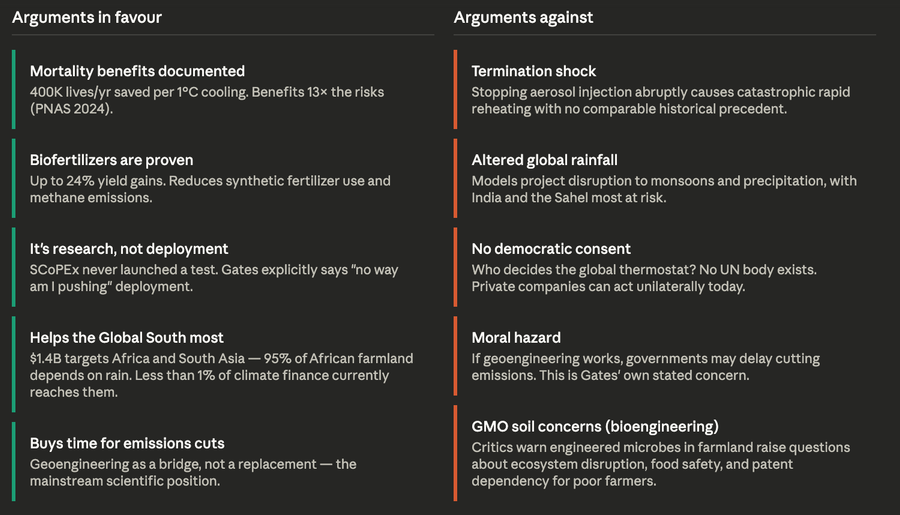
On the other hand, Gates’s much larger and less-discussed project is not in the sky whatsoever. It actually is in the soil. In late 2025, the Gates Foundation pledged $1.4 billion over four years to help smallholder farmers in sub-Saharan Africa and South Asia adapt to climate change. A significant piece of that funding is targeted towards biofertilizers - living microorganisms like bacteria and fungi that help plant roots absorb nutrients from the soil without synthetic chemicals. Field Trails so far have shown yield gains of up to 24 percent. In a region where 95% of farmland depends on rainfall, crop failures are already rising across the country. So this doesn’t seem like a controversy but rather just a great initiative towards agriculture sector.
So what are those trails in the sky?
The short answer is: Water. See, jet engines burn fuel, which then produces hot water vapour. At a cruising altitude of around 30,000 to 40,000 feet, the air is extremely cold, typically around -40 degrees Celsius. When hot exhaust meets that cold air, the vapour instantly freezes into tiny Ice crystals. That right there is a contrail - condensation trail. This is the same basic physics as your breath on a winter morning, the fog you see when exhaling. That right there.
Now, another question you may ask: Why do some of these contrails persist for hours while others vanish in seconds? Well the short answer is - Humidity. In dry air, ice crystals sublimate quickly, and the trail disappears. But in air that is already close to ice-saturation, the crystals persist and spread, sometimes forming sheets of thin cloud which are harder to distinguish from natural cirrus. And of course, this is not a secret. It has been understood since the 1940s, when the military pilots first noticed this phenomenon.
In 2016, a survey of 77 of the world’s leading atmospheric scientists found that 76 of them had found no evidence of a secret spraying program, and that every piece of alleged “chemtrail” evidence cited by believers could be explained by normal contrail physics and humidity variations. The EPA published a fact sheet explaining contrail science as early as 2000. The science here is not contested.
So what you are actually seeing is just a normal contrail. These normal contrails are being observed against a backdrop of genuine, real, ungoverned geoengineering activity. But as of now, these two stories are being confused, so the truth has to be separated.
The real story: no one is in charge
While Harvard was cautiously running models and debating whether to release 4.4 pounds of chalk dust, a two-person American startup called Make Sunsets was already doing something far more aggressive.
Since February 2023, Make Sunsets has launched 147 balloons and sold 128,000 “rolling Credits” to paying customers. Each credit presents the offset equivalent of one ton of CO2, delivered by release sulfur dioxide into the stratosphere from balloon launches in undisclosed locations. The Company openly sells these credits on its website. It charges real money, and it also modifies the shared atmosphere of the entire planet.
When Mexico government discovered that Make Sunsets had launched two prototype balloons from Baja California, it immediately announced plans to ban solar geo-engineering nationally. Over 110 climate scientists signed an open letter stating that solar geo-engineering “likely will never be an appropriate candidate for an open market system of credits”. David Keith, the Harvard scientist who led SCoPex and is now at the University of Chicago, does not support Make Sunsets. “I think private companies should have no role in this space,” said Shuchi Talati, a leading climate governance expert. “The notion that there’s a company out there doing this and trying to profit off it is offensive.”
In late 2025, an Israeli company called Stardust Solutions raised $60 million, positioning itself to sell geo-engineering capabilities directly to governments. As of now there is no international treaty that governs any of these activities and businesses. No UN enforcement body and no agreed definition of what constitutes an illegal atmospheric deployment. The governance gap is not a future problem. It is an open door, as of now.
Does the Science actually work - and at what cost?
To understand whether if any of this is worth the risk, first we need to look at what the research actually says. In 2024, a peer-reviewed study published in the proceedings of the National Academy of Sciences, led by scientists at Georgia Tech and Princeton, modeled what would happen if solar geo-engineering cooled Earth’s average temperature by about 1 degree Celsius.
The findings were a bit Striking. Roughly 400,000 lives would be saved per year - primarily in hotter, poorer regions that usually bear the worst consequences of climate change. The mortality benefits outweighed the known harms(though it is debated and many people disagree), which include ozone damage and air pollution from aerosol particles by a factor of 13 to 1.
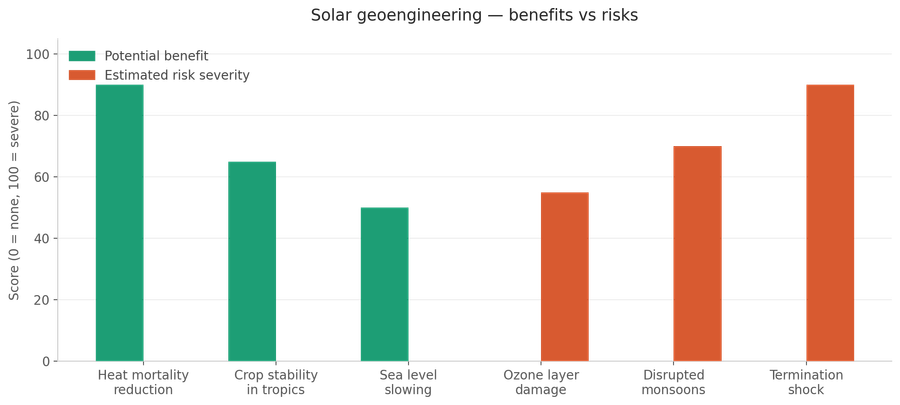
There are also some serious questions about who wins and who loses. Models suggest altered rainfall patterns in South Asia and the Sahel, precisely the regions that geo-engineering is supposed to protect. Reducing solar radiation affects how monsoons form. India is formally opposed to geo-engineering deployment for exactly this reason, even while its scientists study it. The irony is heavy: a technology designed to help the world’s poorest could most directly harm them in the process.
What does the public think — and what are governments doing?
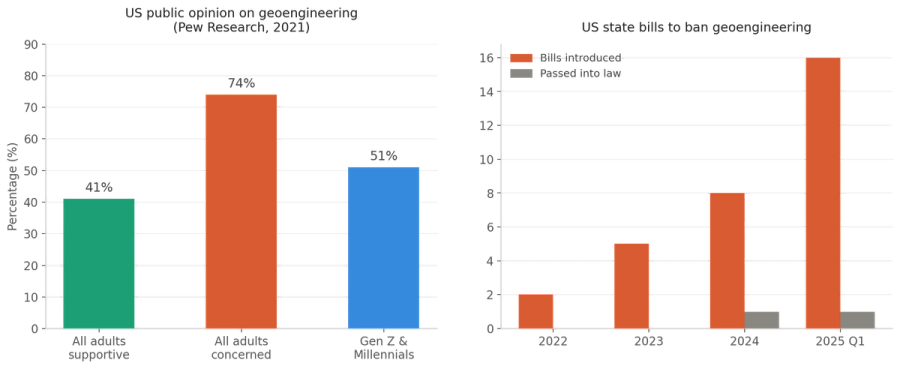
Public opinion on this is genuinely divided, and it is shifting quickly. A 2021 Pew Research Center survey found that about 41 percent of American adults believed solar geo-engineering could help mitigate climate change, but 74 percent expressed concern about the consequences. More than half of Generation Z and millennials said they were open to it.
Politically, the backlash has accelerated. In the first three months of 2025 alone, more than 16 US states introduced bills to ban solar geoengineering. Tennessee passed one into law in 2024. Many of these bills were introduced in Republican-led states, some referencing chemtrail conspiracy theories in their text. At the international level, the UN Environment Assembly failed in 2024 to reach consensus on even forming an expert group to study the issue. The EU's chief scientific advisers called for a moratorium on deployment. The world cannot agree on what to call this problem, let alone how to govern it.
Is this good or bad?
Well, it depends entirely on which part you are looking at and on who gets to decide.
The science on benefits is quite real. Saving 400,000 lives a year from heat-related illness is not something to be ignored. The biofertilizers program is showing genuine results for farmers who have no other alternative. The argument for researching these technologies, not deploying them but understanding them, is defensible and supported by a large number of climate scientists.
But the governance picture is genuinely alarming. Solar geo-engineering, if ever deployed, cannot simply be switched off. It would require a multigenerational commitment, with shared risks distributed unequally around the planet. And right now, the decision about whether to start could be made by a startup with two employees, a launch site in an under-regulated country, and a website selling cooling credits.
Gates himself is the most honest voice on the risks of what he funds. He has explicitly named moral hazard — the fear that geo-engineering will become an excuse not to cut emissions — as a legitimate reason to be cautious. He says he is not pushing for deployment. He says he wants the knowledge to exist so that when genuine tipping points arrive, humanity is not making decisions in the dark.
That is a reasonable position. It is also not the one most people online associate with him.
The sky is not the story
Look up at those white lines again. What you are seeing is physics, not conspiracy — ice crystals formed in cold air, their persistence determined by humidity, their shape by wind. The planes causing them are the same planes they have always been.
But the anxiety those trails carry? That points at something real. There is a small group of scientists, entrepreneurs, and billionaires making decisions about the shared atmosphere of eight billion people, largely outside public scrutiny, with no agreed rules, and with potentially irreversible consequences. Not through contrails. Through balloons, boardrooms, and billion-dollar pledges.
That story deserves more attention than a conspiracy theory. Because, unlike the conspiracy, it is actually happening.
Sources: Proceedings of the National Academy of Sciences (2024), Harvard SCoPEx programme records, Gates Foundation COP30 fact sheet, Pew Research Centre (2021), Science News, MIT Technology Review, Inside Climate News.