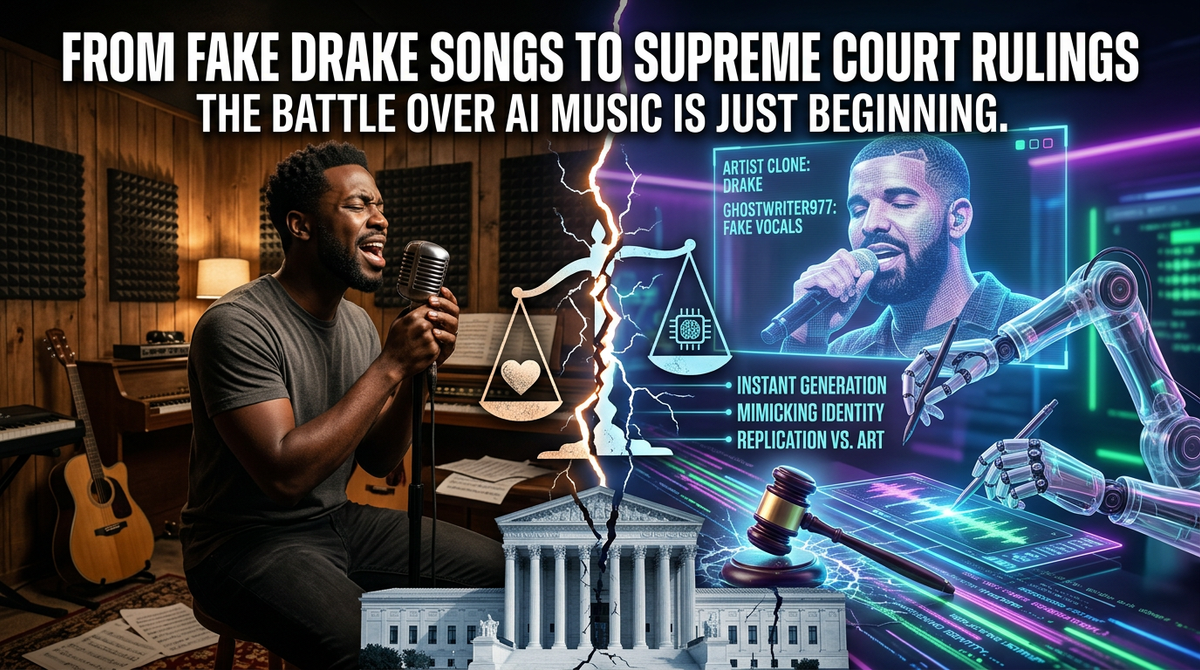
From fake Drake songs to Supreme Court rulings, the battle over AI music is just beginning.
Music has never been just sound. Rather, music is the emotion, the imperfect expression, the human expression. It is not something that is given as an assignment with an end date, nor is it something to check off as an exercise in financial gain. For centuries, music has been created as an expression of something that could not be expressed through the use of words.
But now, that foundation is being threatened.
AI can generate songs in seconds – mimicking voices, styles, and even emotions. What once took years of learning, failure, and growth can now be replicated instantly. And that raises a difficult question:
If music can be made without feeling, is it still art?
Artists are starting to push back – not because they fear technology, but because they understand what’s being replaced.
Ed Sheeran called it “weird.”
Drake saw his own voice copied and called it the “last straw”.
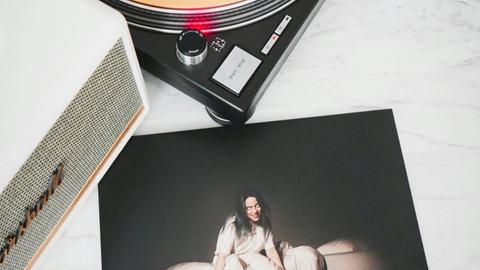
Billie Eilish and others warned that AI isn’t just assisting art – it’s imitating identity. Because this isn’t about tools anymore. It’s about replication.
AI song controversy
Two years ago, an AI-created song caused a lot of controversy in the music industry. A TikTok ghostwriter977 created the song called " Heart on My Sleeve, " which sounds like an original song by Drake and The Weekend, two of the biggest artists in the world. The song even has the same AI beat in the same style as METROBOOMIN and even starts with the producer's iconic sound. Without knowing it was AI, someone could easily confuse the song as authentic because of how realistic it sounds. The song generated more than 600,000 streams on Spotify, 15 million views on TikTok, and 275k views on YouTube. The song was pulled from music streaming services by the Universal group, the artists’ record label, which condemned the infringing content generated with AI.
However, a couple of years ago, Stephen Thaler, a computer scientist of St. Charles, Missouri, applied for a federal copyright registration in 2018 covering "A Recent Entrance to Paradise," a visual art he said his AI technology "DABUS" created. The image shows train tracks entering a portal, surrounded by what appears to be green and purple plant imagery.
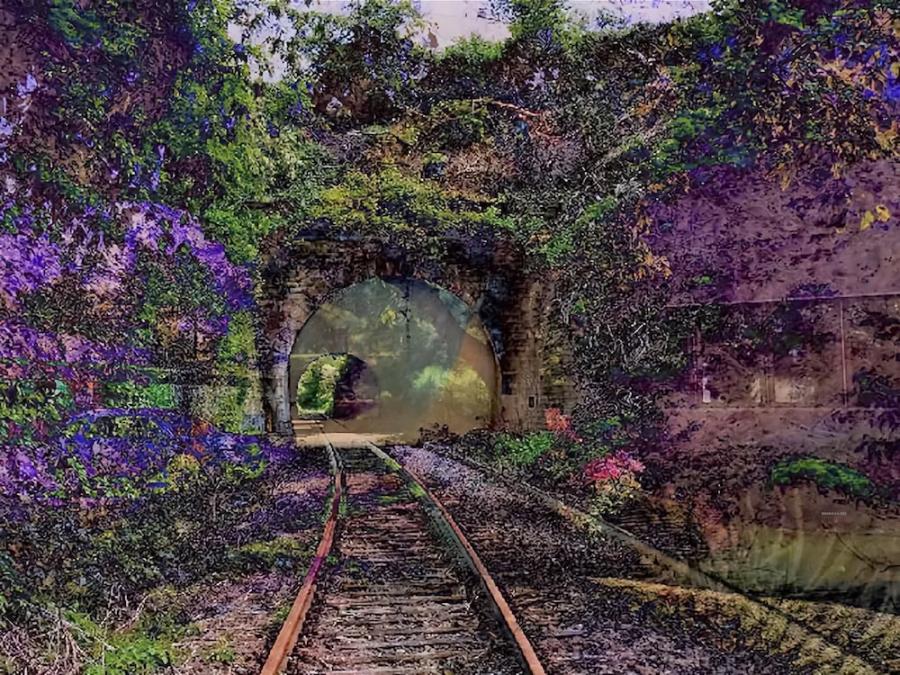
The US Copyright Office denied this because it didn’t have human authorship; they appealed this decision, sent it upstairs, and it went all the way to the Supreme Court. And, as of March 2, 2026, the Supreme Court denied a hearing in the case. Which simply means you cannot copyright AI-generated art, any form of AI-generated art. Basically, if you cannot register something through copyright, that means you cannot own it, that means you cannot collect royalties. Hence, you cannot monetize. This means there will be a big backlash for AI music artists, who have made progress in the past few years. They may not have the same financial support to continue doing that.
What does this mean for AI-generated music? Because revenue in the music industry does not primarily stem from streaming alone, but rather from licensing, branding, and advertising, the inability to secure copyright protection fundamentally changes its value. Without legal ownership, AI-generated music effectively exists in the public domain, meaning it can be used, reproduced, or modified by anyone, at any time, for any purpose.
This is a concerning thought for a lot of companies and marketing agencies, too. Advertising campaigns, particularly those relying on distinctive audio branding or jingles, depend on exclusivity to build recognition and identity. If such content is generated through AI and cannot be protected, competing brands could legally reuse or replicate the same material, undermining its uniqueness and commercial effectiveness.
In essence, while AI enables rapid and cost-efficient music production, the absence of ownership may ultimately limit its viability as a reliable asset in commercial and creative industries.
Think about it. If anyone can create music instantly, what happens to those who spent years learning it?
And if art no longer needs an artist, what exactly are we listening to?
AI can learn patterns, but it has never felt a single lyric. And maybe that’s the difference that still matters.