The “News Will Find Me” Trap
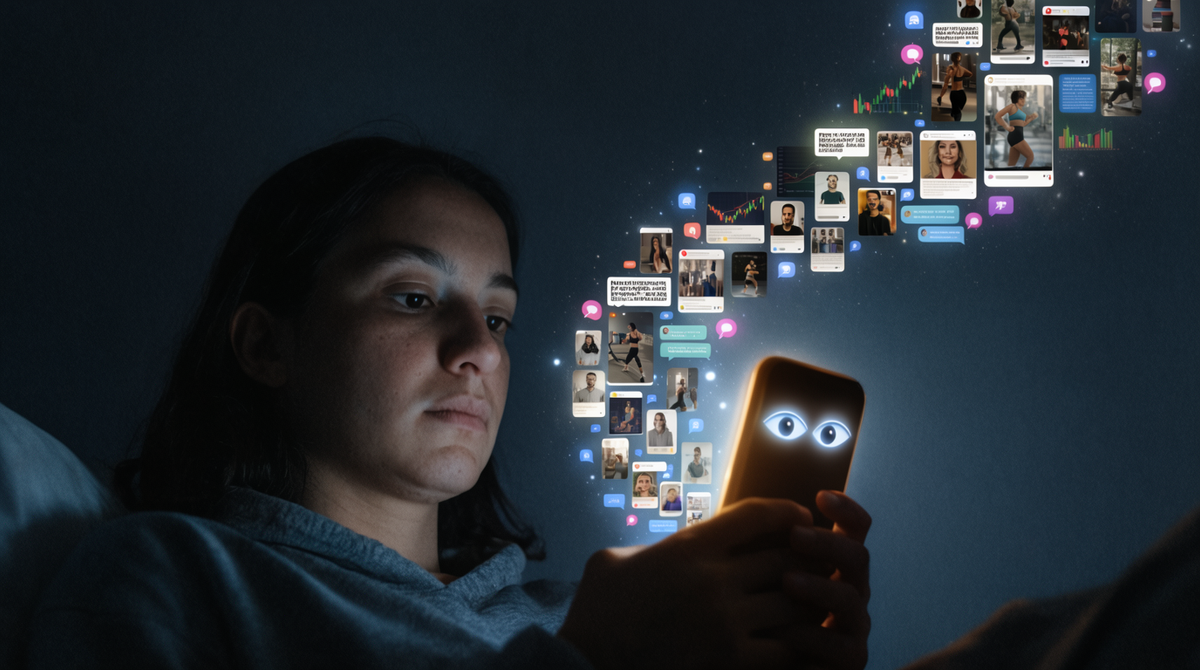
Nowadays, you don’t have to go and read a whole newspaper or an article which might take you 10–15 minutes. All you have to do is just scroll Instagram, and somewhere between the reels, a guy is restoring an old motorcycle, some fintech influencer is talking about the latest stock market crash, the fitness coach and health influencer talking about a new breakthrough in medical science and many more. The world updates itself right in front of your eyes, on a tiny screen. It all arrives without you ever typing it into a search bar or picking up a newspaper. And a lot of us live like this now. Penn State researchers found that roughly one in three people have stopped seeking the news out altogether — they just wait for it to find them. It sounds efficient. But the study suggests that it’s quietly rewiring who we trust. Not just at individual level but at a societal level.
The flattening
The Penn State team, led by S. Shyam Sundar and first author Mengqi Liao, ran an experiment with 244 people. Everyone first took a survey that measured how strongly they held the “news will find me” mindset. Then each person was dropped into one of three simulated news feeds. The articles were identical across all three. The only thing that changed was who recommended them — a professional editor, your social media friends, or an algorithm. Here’s the finding that should give you pause and make you reconsider your news sources from now on. People high in NFM rated the algorithm’s picks and their friend’s shares just as credible as the stories handpicked by professional editors and reporters. The source didn’t matter to people. A machine’s recommendation carried the same authority and credibility as a newsroom’s. People lower in NFM behaved a bit differently. They were more skeptical of the algorithm, more discerning about where a story came from, and they placed real value on the judgment of editors and journalists.
Sundar’s co-author Homero Gil De Zúñiga calls this a flattening of authority. A world where social media feeds get trusted like professional journalism, where, as he puts it, the algorithm now carries the same weight as a journalist.
Why your brain does this
Well, we don’t actually evaluate every piece of information we are bombarded with while we scroll,because that would become a really big hassle — there’s too much of it. So the brain takes shortcuts, mental rules of thumb that researchers call heuristics. The study isolated two of them.
The first is the machine heuristic. When a recommendation comes from an algorithm rather than a person, we tend to assume that it’s already neutral. Objective. Math does not have an agenda, so the logic goes, therefore the machine must be fair. Of course an algorithm is built by people, trained on choices, and optimized for engagement — but it doesn’t feel that way when it’s just quietly serving you content.
The second is the homophily heuristic. We tend to trust information more when it’s shared by people we see as similar to ourselves or people who we are familiar with. A friend who thinks like you, votes like you, maybe even lives like you — when they share something, it slips right past your guard. It feels less like a claim to verify and more like a confirmation of what we already believe.
Why this is a problem
It is not because the algorithm and the friends will always be wrong. It is about what may happen when there is an attempt to take advantage of that. In the old system, deception required that the reader was fooled by pretending to be a legitimate media source, which was difficult because it had to sound and look like genuine journalism. But in the flat world, all that is required is to manipulate the algorithm or use the social network effectively. With the news feed being the trusted source, the bad actor simply needs to get into the news feed.
Think about how this plays out. A fake health “breakthrough” or a doctored screenshot gets posted somewhere, a few people share it, and it lands in your feed through someone you actually know. You don’t stop to fact-check it, because it didn’t come from a stranger — it came from a friend who thinks like you. That’s all it takes. For this reason, the authors explain that persons with high NFM tend to be more susceptible to deception and, at the same time, less knowledgeable. It does not mean that such people do not think. They have just handed the task of determining credibility over to a system that was never meant to deal with it truthfully.
There is another, silent price for such behavior as well. Sundar mentions the point that as people stop looking for information by themselves, fewer subscriptions appear, and professional journalism, which is costly and takes much effort, is replaced with “machine as a source.” The very means of checking the power becomes deprived of funding because of our laziness.
“Machine as a source is now becoming predominant, undermining the more traditional professional sources, and that’s worrisome.”
S. Shyam Sundar, Penn State
What you can actually do
You’re not forced to unsubscribe from your feed or pretend it’s 2005. But you can introduce some friction back into the process. It takes very few practices to achieve this:
Check who says what before you assess if it’s true. Even if the algorithm recommendation appears next to a journalistic report in the same scroll, they are fundamentally different things.
See confirmation as a yellow light rather than a green light. Those reports which appear most obviously true, especially the ones your friends with whom you are most similar are sharing, are the ones where the
homophily heuristic works the hardest. And once in a while, go and get the news rather than having it delivered to you. Select one or two reliable sources and actually visit them. The very act of selection is key. It’s the difference between being informed and being fed. The feed isn’t going anywhere. The only question is whether you read it or it reads you.
Study: Liao, M., Sundar, S. S., et al., published in social media & Society (2026). Reporting via Penn State’s Bellisario College of Communications.