
The crossover
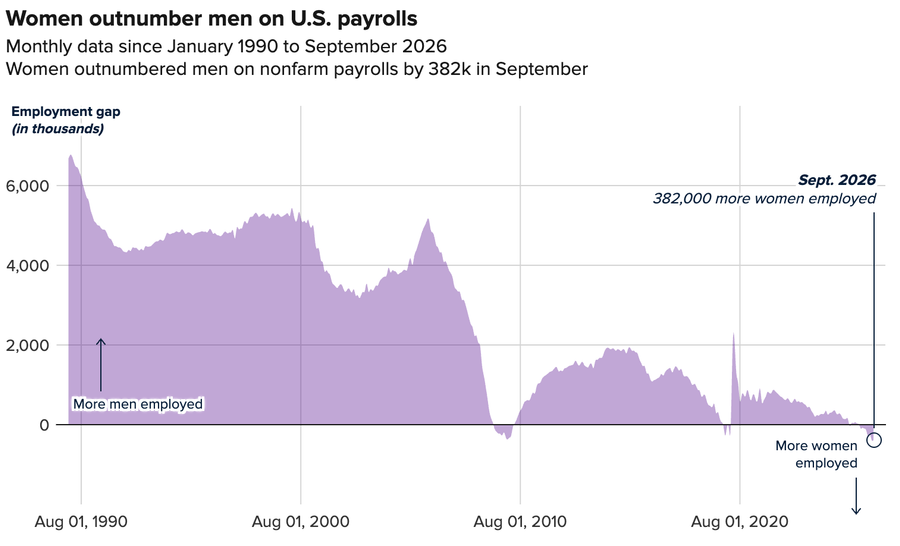
For eight months running into September, according to Indeed's analysis of government data, women have been in greater number than men in the workforce — the longest such sequence since 2010. The figures are clear: the seasonally adjusted number of employed men was roughly 1.2 million less than the previous year, while women's employment had increased by more than 650,000 over the same period. The last time the gap had appeared like this, it was due to men being made unemployed. This time, as Indeed's economist stated, the gap is the result of women securing jobs, not because men are losing them.
It's the sectors, not the men
The reason is not mysterious and it has nothing to do with gender attitudes—it's a matter of where growth is focused. Healthcare has always been the engine behind the US job market and accounted for more than half of all payroll growth in September. Nearly four out of every five healthcare workers are women. Whenever a sector dominated by women is the one responsible for most of the hiring, the workforce becomes female almost automatically. Men are overrepresented in the industries which are not currently seeing job growth; women are overrepresented in the one that is. That is the entire source of the imbalance.
Why the trend may be wobblier than it looks
The aspect that contradicts the headline is that the same report indicates the tilt might be easing. In September healthcare employment increased more slowly than its recent average, so the benefit to women from it was smaller than in previous months. At the same time, sectors which employ a high proportion of women, such as government, actually saw a contraction, which reduced women's overall gains. As a result, men made up just over half of the net job growth in September — a marked change from the previous month when they had accounted for only 2 per cent of it. Since in that month total payrolls increased by only 29,000 against an expected rise of 84,000, these gender splits are being drawn from a very narrow slice, making the gender distribution in any one month highly volatile and prone to being misinterpreted.