How do we remember space? A grainy photo of a footprint. A blurry TV broadcast of a man in a bulky suit and somehow a gray-haired, clean-cut television anchor with a neatly trimmed gray mustache and classic black-rimmed glasses.
In under 70 years, we went from not being able to leave the atmosphere to catching a skyscraper-sized rocket booster out of the sky with metal arms. That’s not luck. That’s humanity’s craziest acceleration curve we have witnessed.
Here are all the major milestones, grouped by what each one actually unlocked.
First Contact With Space
It all starts in 1957, when the Soviet Union launches the first artificial satellite, Sputnik 1, into orbit. The thing is the size of a beach ball and does nothing except beep, but that beep changes everything – the space age has officially started. Weeks later, Sputnik 2 carries a dog named Laika into orbit, becoming the first living creature in space and proving biology can survive the trip, even if the mission itself is a one-way ticket. In 1958, the U.S. formally entered the race by founding NASA. Then in 1961, Yuri Gagarin became the first human to reach orbit and return alive, finally answering the question “can we survive space” for the first time. Two years later, Valentina Tereshkova became the first woman in space, on only her second-everflight of any kind. And in 1965, Alexei Leonov performed the first spacewalk, stepping outside a spacecraft while it’s orbiting Earth at 17,000 mph.
Reaching the Moon
The Moon becomes the next obvious target. In 1959, Luna 2 became the first human-made object to reach another world, crashing onto the lunar surface. It takes until 1966 for Luna 9 to pull off the first soft landing, proving a spacecraft can touch down gently instead of crashing. Humans get their first close look in 1968, when Apollo 8 becomes the first crewed mission to leave Earth’s orbit entirely and circle the Moon – the mission that gives us the famous “Earthrise” photo. Then, in 1969, Apollo 11 delivers the big one; humans walk on the Moon for the first time, a feat no other country has matched since.
Learning to Live in Orbit
Getting there was one problem. Staying was another. In 1971, Salyut 1 became the first space station, proving humans can live and work in orbit for extended stretches, not just visit. Ten Years later, the Space Shuttle becomes the first reusable orbital spacecraft, letting NASA fly the same vehicle over and over instead of building a new rocket every time. By 1998, assembly begins on the International Space Station, and by 2000, humans have a continuous, unbroken presence in space for the first time in history.
Exploring Other Worlds by Machine
While humans stayed close to home, machines pushed further. Viking 1 becomes the first spacecraft to land on Mars and function long-term in 1976. Voyager 1 and 2 launch in 1977 with no expiration date built in — they're still going. Hubble follows in 1990, giving humanity its clearest view yet of the universe. Mars Pathfinder's rover Sojourner becomes the first rover on another planet in 1997. By 2012, Voyager 1 becomes the first human-made object to leave the solar system's heliosphere entirely. New Horizons delivers the first close-up images of Pluto in 2015, and in 2022, the James Webb Space Telescope sends back its first images of the universe's deep past.
Making Space a Business
Somewhere around 2008, the story quietly shifts from government agencies to private companies. SpaceX’s Falcon 1 becomes the first privately developed rocket to reach orbit, the moment the economics of space start to change. By 2012, SpaceX’s Dragon becomes the first private spacecraft to dock with the ISS, proving commercial companies can deliver cargo to the space station. The real turning point comes in 2015; Starship takes it further still, with the Shuttle retired. And in 2024-25, Starship takes it further still, with SpaceX catching a rocket booster out of the sky using giant mechanical arms on the launch tower, skipping landing legs entirely.
The New Frontier
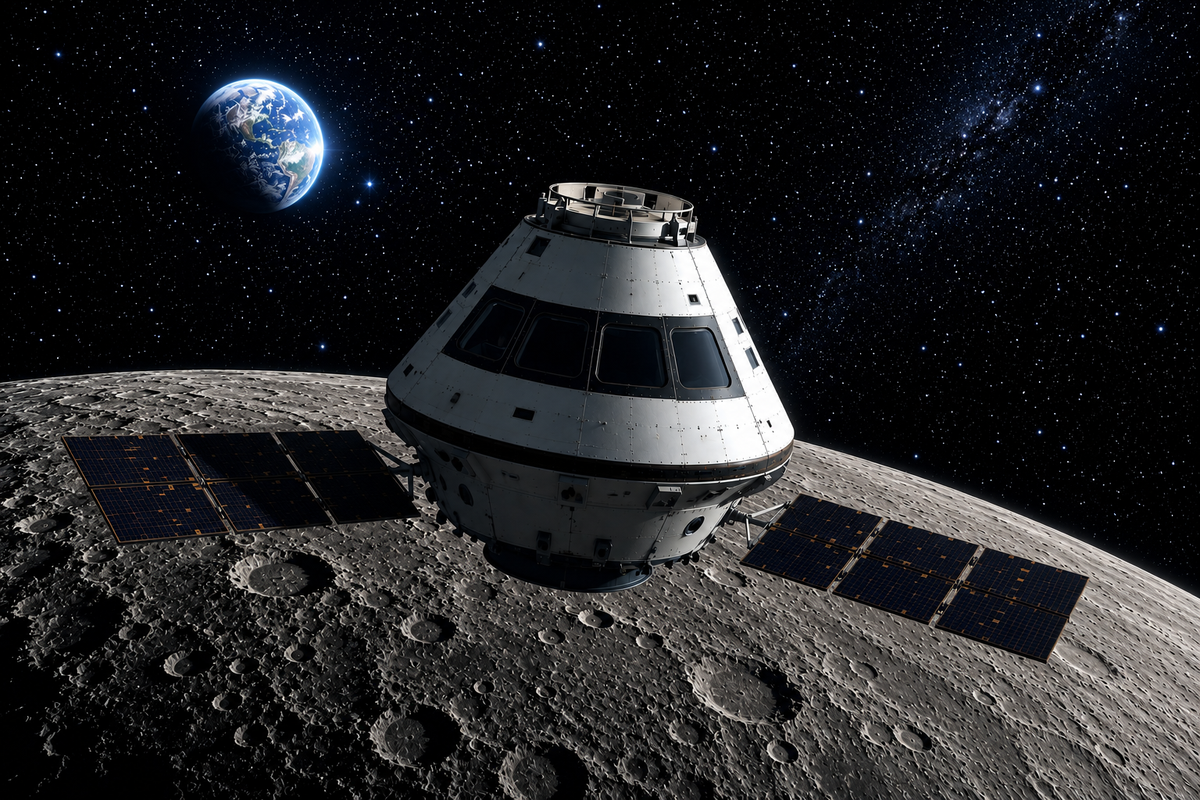
The most recent milestones stretch in every direction. In 2021, the helicopter Ingenuity achieves the first powered flight on another planet, lifting off in Mars' paper-thin atmosphere. In 2023, India's Chandrayaan-3 becomes the first mission to land near the Moon's south pole. And in 2026, Artemis II carries four astronauts around the Moon and back — the first crewed lunar mission since 1972, setting up humanity's return to the lunar surface after over 50 years.
Look at that list end to end and a pattern shows up: the first half of this timeline is about proving humans can survive out there. The second half is about making it routine. We didn't just go to space. We built a way back.