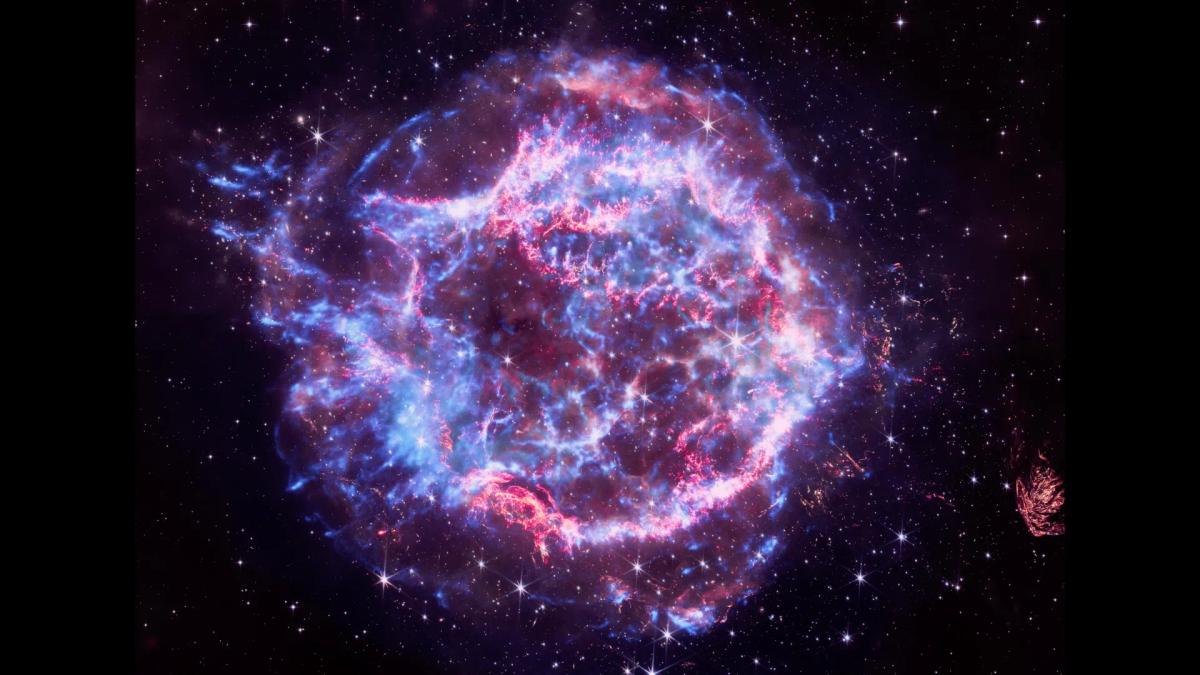
When celebrating America’s 250th birthday, NASA did not use fireworks, but sent its probes much further into space, taking four pictures with lots of red, white, and blue. The observatory decided not only to show the pictures but also turned three observations into sound, giving you an opportunity to listen to a supernova just like looking at it. All four images are based on the work of the Chandra X-ray Observatory – the instrument of NASA designed to observe violent and heated phenomena in the universe – supplemented with information gathered by Hubble, Webb, and even amateur photographers. Below you can find a brief description of the images NASA took. The exploding star. First in our list is Cassiopeia A – one of the most well-known exploded stars in the Milky Way. Chandra’s X-rays (in blue and purple colours) depict the explosion’s shock wave and ejected materials – iron, calcium, and oxygen, which will form new planets in the future. Webb’s infrared image (in red and white colours) shows the expansion of the debris of the star and dust scattered around it.
The stellar nursery. Another image is the NGC 3603, which is an active nebula that has a dense group of recently formed stars. Chandra spots the bright points of x-rays from these newly formed stars and Hubble captures their surroundings that include gas and dust clouds. Therefore, this picture appears to be a maternity room of thousands of suns. The galaxy with a glowing waistband. The next image is Messier 94, which is a spiral galaxy with an actively shining "starburst ring" in its centre, where a lot of stars are being born. It is believed that the oval shape of this galaxy pushes gas toward the ring and thus contributes to the process. Chandra's x-rays and visible-light pictures – taken even by amateur astronomers – help to highlight this region.
The dark matter smoking gun. Finally, here is ZwCl 0024+1652, an ancient galaxy cluster and one of the most convincing proofs of the existence of dark matter in the entire universe. Hubble image, specially processed to show dark matter distribution (blue), is combined with the red glow of Chandra's super-heated gas cloud. And here lies the proof that all this gas in one place has more mass than all galaxies in this cluster together.
Why it matters: Besides the patriotic makeover, the gallery highlights how astronomy works in the modern age – one telescope does not give the whole story. From X-rays to infrareds to optics to ultraviolet, all of these technologies capture a different piece of the puzzle, and only when put together will they reveal the whole image of the object that is thousands of light-years away. This year, while our barbecues were lit on Earth, NASA made sure to remind us that the fireworks were going on in the galaxy for millions of years before.