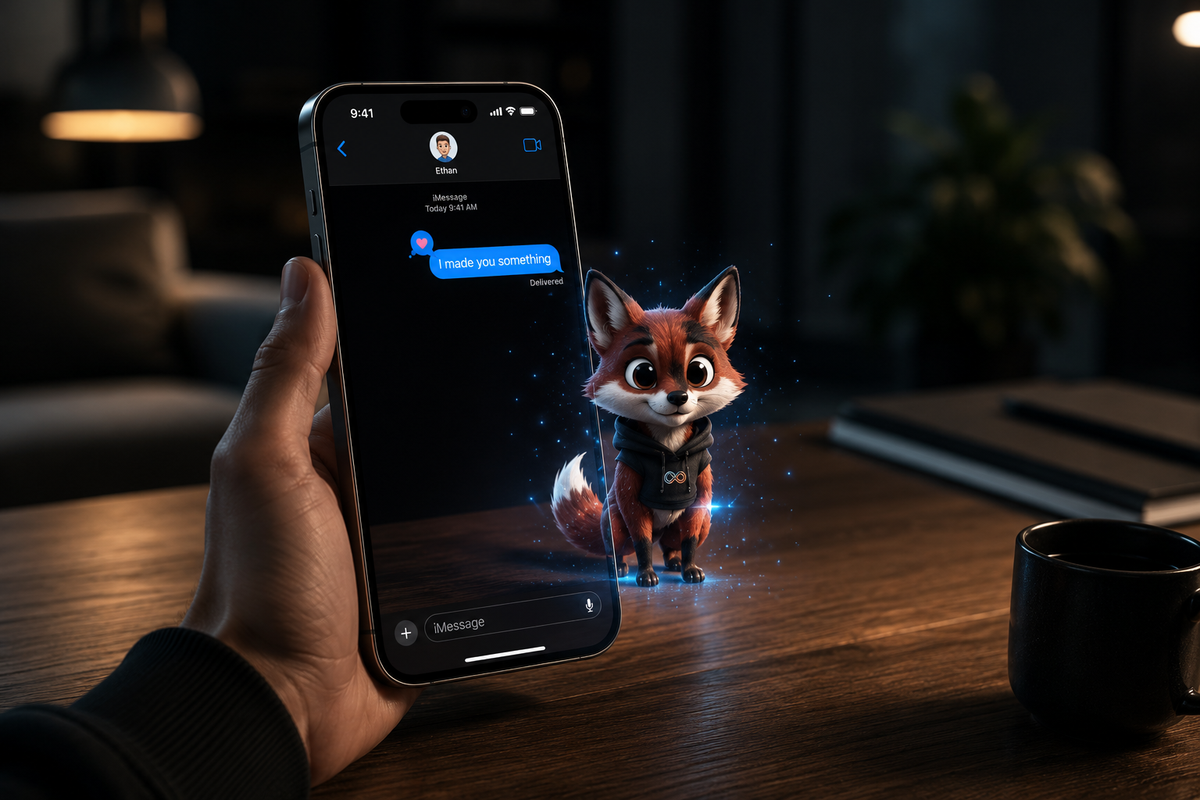
A talking cat has just perched itself on the couch of a reporter and told him some jokes. The cat responds to actual barking dogs, syncs itself to the music playing in the room, and most importantly, it doesn’t send a single piece of information about anything it sees or hears to the cloud. The cat is a toy; the underlying bet is definitely not: A four-person startup that has been founded by a visionary from Apple and the Vision Pro believes the future of AR lies in the smartphone you’re already carrying in your pocket.
The ten-year-old promise of AR was the same: put something on your head. Meta spent billions on it. Apple released a $3,499 headset to make its case. But when one company called Pixi Platforms took all that tech into account, it decided that the "magic looking glass" for augmented reality lies in what three billion people already have in their hands.
Its app converts your iPhone into a portal to send AR characters to other people via text messages. Imagine it like animated greeting cards that have a mind of their own – a chatty cat, a robot that will win you at tic-tac-toe, an envelope following you through the room to deliver your message in person. The characters can be sent to others via iMessage, who must download the app in order to view the character appear right in front of them.
Cute. Here, however, comes the founder’s actual argument, and it’s what makes sense: the phone works better as an AR tool because it does things people are going to use the technology for. It’s already in everyone’s pocket, there’s no set-up required, and, unlike goggles, it can be used by more than one person at once. Isolation is inherent to the headset; using the phone sitting on the couch makes it a group activity.
And then the real steal of the show – while all the AI products currently in development default to collecting user data at a server farm somewhere, Pixi chose to do the exact opposite. The audio and video input the character interacts with stays strictly on the phone. The models created by Frontier are used to develop the application, but a much lighter model powers the character on the device. At a time when “AI-powered” essentially means “we’re recording your living room,” Pixi believes that privacy-by-default will become a feature worth paying for.
And that's the point, not the cat. The quote by the founder contains the thesis statement entirely. In order for Pixi, the company, to become the one on which IP holders can develop their characters as the apps which people can use in order to text each other, it must have brand-safe behavior coded into it. A kid-friendly character cannot swear or react to swearing. A more edgy one will have some more lenient restrictions, but it still will be a character which won't register any obscene information.
Think it through, and you'll get the picture: it's Disney, but distributed through your group chats in the form of sendable, sensing, brand-safe little programs, monetized through movie/TV release deals. The investors are already including the AI Fund founded by Andrew Ng and Framestore, the VFX studio.
Our take: the talking cat is a Trojan horse. The two ideas smuggled inside it — that ambient AR belongs on the phone, and that the winning AI products keep your data local — are the ones that outlast the novelty. Everyone chasing the metaverse built for the headset and the cloud. Pixi is quietly betting the future is the boring rectangle in your pocket, doing more by uploading less.
Check out Pixi official site: https://sendpixi.com